What Is Digital Marketing?
Digital marketing is the practice of promoting a business, product, service, organization, or personal brand through digital channels. Those channels include search engines, websites, social networks, email, online advertising, video platforms, mobile applications, marketplaces, messaging platforms, and increasingly AI-powered search and recommendation systems. Unlike traditional marketing, digital marketing gives businesses an unusually detailed feedback loop: you can see where visitors came from, what they searched for, which page they viewed, what content they engaged with, whether they converted, and how much revenue was eventually generated. That makes digital marketing less like putting a billboard beside a highway and more like operating a control room where every signal can potentially inform the next decision. The global opportunity is enormous. DataReportal reported 6.12 billion internet users worldwide in April 2026, representing 73.8% of the global population, while active social-media user identities reached 5.79 billion. These figures explain why digital channels have become central to customer acquisition rather than simply an optional extension of traditional advertising. The challenge, however, is that the digital environment is becoming much more complicated. Consumers can discover a brand through Google, TikTok, YouTube, Instagram, Reddit, marketplaces, influencers, newsletters, WhatsApp, or an AI assistant before they ever visit the company's website. Modern digital marketing therefore isn't simply about getting more traffic. It is about being discoverable, credible, memorable, useful, and measurable across the entire customer journey.
How Digital Marketing Has Changed
The basic principles of marketing have not disappeared, but the mechanisms have changed dramatically. A decade ago, many businesses could build a website, publish keyword-focused articles, run Facebook advertisements, and expect relatively predictable results. Today, every one of those activities operates inside a much more crowded ecosystem. Search engines increasingly provide answers directly on the results page, social platforms behave like discovery engines, advertising platforms use machine learning to determine audience delivery, and generative AI has made content production dramatically faster. Google's own 2026 guidance says that traditional SEO practices remain foundational for its generative AI search experiences while emphasizing valuable, unique, non-commodity content. This distinction matters because automation has made producing content easy, but it has not made producing valuable content easy. A company can generate 500 blog posts with AI, but if those pages say the same things as thousands of competitors, they may add little value to users or search systems. The modern marketer therefore has to combine technology with original research, customer understanding, brand positioning, data analysis, and editorial judgment. Think of AI as a powerful engine rather than the driver. It can accelerate research, ideation, production, personalization, testing, and analysis, but someone still needs to decide where the vehicle should go.
Why Digital Marketing Matters in 2026-2027
Digital marketing matters because customers increasingly conduct parts of their entire buying journey online. Someone considering a new laptop may watch YouTube reviews, search Google for comparisons, ask an AI assistant for recommendations, read Reddit discussions, inspect Instagram content, compare prices on marketplaces, and finally visit a retailer. A person searching for a doctor may look at Google Business Profile information, reviews, location, social content, and a clinic website before calling. A B2B buyer may download a report, subscribe to a newsletter, attend a webinar, interact with LinkedIn content, and speak to sales weeks later. The path is no longer a straight funnel. It resembles a web of interactions where every touchpoint can influence the next one. DataReportal's April 2026 figures show that people spend substantial amounts of time consuming digital media, with internet users averaging more than 33 hours of online-media consumption each week and social/video activity accounting for a significant portion of that time. For businesses, this creates both opportunity and competition. Being online is not enough; businesses must understand where their specific customers spend attention and what information they need at each stage of the journey. A strong digital strategy connects those moments instead of treating SEO, social media, advertising, email, and content as isolated departments.
The Growth of Digital Audiences
The scale of digital audiences also changes the economics of marketing. A local business can target a relatively small geographic area, while an ecommerce company can potentially reach customers across continents. A specialist consultant can use search content and LinkedIn to reach a narrow professional audience, while a consumer brand can use short-form video to reach millions of people. Yet audience size should never become the only objective. Ten thousand highly relevant visitors can be more commercially valuable than a million people who have no reason to buy. This is why modern digital marketing increasingly focuses on intent, relevance, conversion quality, customer lifetime value, and retention rather than vanity metrics alone. DataReportal's latest global update also shows that generative AI usage has expanded rapidly, with its April 2026 analysis estimating 2.42 billion active generative-AI users, although it cautions that such figures may not represent unique individuals. The implication for marketers is straightforward: customers now have more ways to discover information than ever before. A business that only optimizes for traditional Google rankings may miss conversations happening inside AI tools, social platforms, communities, video search, and other discovery environments. The winning approach is not to abandon established channels but to connect them into a coherent ecosystem.
The Core Digital Marketing Channels
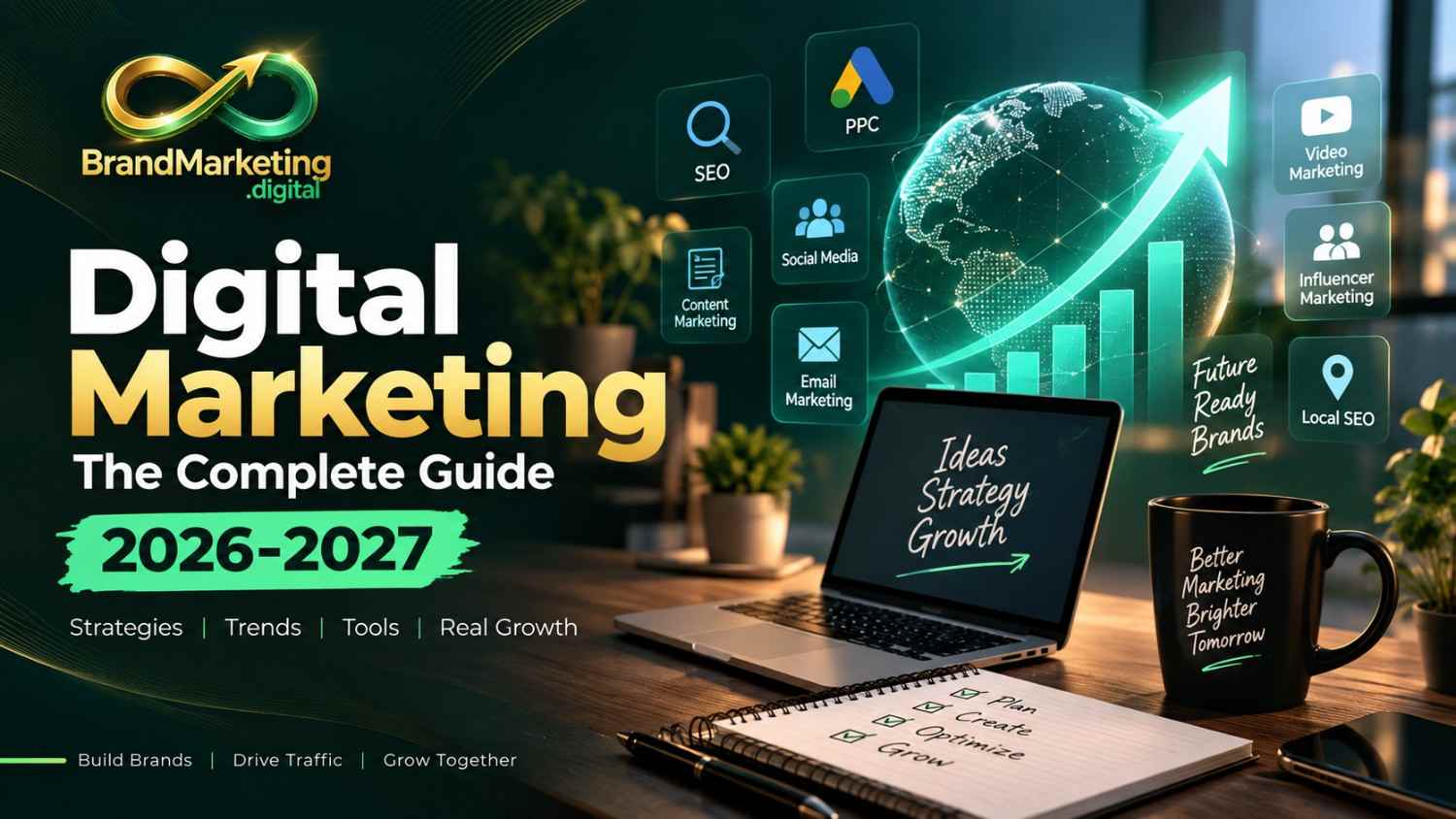
There is no universal list of channels that works for every organization. A local dentist, SaaS company, fashion ecommerce store, international school, financial platform, and restaurant can require completely different combinations of digital tactics. Still, the major channels can be grouped into several broad categories: SEO, PPC, social media, content marketing, email, video, influencer marketing, affiliate marketing, online reputation, conversion optimization, and analytics. Each channel has a different role. SEO can capture existing demand, paid advertising can create immediate visibility, social media can build attention and community, content can educate buyers, email can nurture relationships, and analytics can reveal which activities produce business outcomes. The mistake is to treat channels as independent silos. A strong campaign can use a search query to inspire an article, turn that article into a video, use the video in paid social campaigns, retarget visitors through advertising, capture email subscribers, and use customer questions to create the next generation of content. In other words, one good insight can become an entire marketing system rather than a single post.
Search Engine Optimization
SEO remains one of the most important digital marketing disciplines because it helps businesses become discoverable when people actively search for information, products, or services. Modern SEO extends far beyond inserting keywords into articles. It involves technical accessibility, information architecture, internal linking, structured data where appropriate, helpful content, topical relevance, reputation, digital PR, local signals, page experience, images, video, and understanding search intent. Google's May 2026 guidance specifically reinforces the continuing importance of established SEO fundamentals while discussing optimization for generative AI experiences in Search. That means marketers should not treat AEO or GEO as magical replacements for SEO. Instead, they should build strong websites and content that can be understood by traditional search systems and newer AI-powered interfaces. Keyword research remains useful, but the question should evolve from "What keyword should I rank for?" to "What problem is the customer trying to solve, and what evidence would make this page the most useful answer?" That shift naturally improves content quality because it forces marketers to think about intent, context, expertise, originality, and trust.
Paid Search and PPC Advertising
Pay-per-click advertising provides something SEO cannot always provide: controlled access to visibility almost immediately. Google Ads, Microsoft Advertising, Meta Ads, LinkedIn Ads, TikTok Ads, YouTube campaigns, retail-media platforms, and other advertising systems allow marketers to target audiences, test messages, allocate budgets, and measure conversions. But PPC is not simply a matter of spending more money. Poor targeting, weak landing pages, inaccurate conversion tracking, irrelevant creative, and unclear offers can consume a budget very quickly. The strongest paid campaigns connect audience, intent, creative, offer, landing page, tracking, and follow-up. A campaign selling a ₹500 product needs a very different economics model from one generating ₹50,000 B2B leads. Marketers therefore need to understand contribution margin, customer acquisition cost, conversion rate, average order value, lifetime value, and payback period. Automation is also becoming increasingly important because advertising platforms now make more decisions about bidding, audience selection, placements, and delivery. Human expertise increasingly shifts toward setting the right business objective, feeding platforms high-quality data, creating differentiated creative, and interpreting results rather than manually controlling every individual bid.
Social Media Marketing
Social media marketing has evolved from simply publishing posts into a broader discipline encompassing entertainment, community, customer service, creator partnerships, paid distribution, reputation, and commerce. The global scale is substantial: DataReportal's April 2026 update estimates 5.79 billion active social-media user identities, equivalent to 69.9% of the world's population, while noting that these identities do not necessarily represent unique individuals. The important lesson is that social media should not be treated as one homogeneous audience. People use different platforms for different reasons and in different contexts. A B2B software company may prioritize LinkedIn and YouTube, a fashion brand may focus heavily on Instagram and TikTok, while a local service provider may gain more value from Google Business Profile, Facebook, Instagram, and messaging. The best social strategy starts with audience behavior rather than whichever platform happens to be trending. Content also needs a purpose: some posts attract attention, some build authority, some demonstrate products, some answer objections, and others encourage conversion. When every post is expected to sell immediately, social media becomes exhausting advertising. When every post is designed only for entertainment, business outcomes may disappear. The balance is attention plus trust plus action.
Content Marketing in 2026-2027
Content marketing is the strategic creation and distribution of useful information designed to attract, educate, influence, and retain a specific audience. Articles, guides, case studies, videos, podcasts, newsletters, reports, webinars, calculators, templates, social posts, product demonstrations, and original research can all be content assets. The biggest change heading into 2026-2027 is not that content has become less important; it is that generic content has become dramatically easier to produce. HubSpot's 2026 State of Marketing research reports that 80% of marketers use AI for content creation and 75% use AI for media production. When almost everyone can produce content faster, publishing more content is no longer a meaningful competitive advantage by itself. Originality becomes the scarce resource. A business needs proprietary insights, customer stories, real examples, strong opinions grounded in evidence, useful demonstrations, expert contributions, unique datasets, or genuinely better explanations. The objective is to create something that would still be worth reading, watching, or sharing even if the reader never knew which company produced it.
AI-Assisted Content and Human Expertise
AI can dramatically improve the content workflow when it is used as an assistant rather than an unquestioned author. Marketers can use AI for topic clustering, research organization, content briefs, headline exploration, transcription, repurposing, translation, data analysis, personalization, and editorial assistance. But human review remains essential, particularly in areas where accuracy, expertise, trust, regulation, or reputation matter. HubSpot's 2026 research describes AI as becoming a baseline capability rather than a differentiator and emphasizes the importance of brand perspective and human-led marketing. That is a useful way to think about the next phase of content marketing. If AI makes content production abundant, then experience becomes valuable. A marketer who has actually interviewed customers, analyzed campaign data, tested landing pages, spoken to sales teams, used a product, or conducted original research can give AI better material to work with. The result is content that feels less like a machine-generated summary and more like a useful expert sitting beside the reader saying, "Here's what we learned, here's what actually happened, and here's what you should consider."
Generative AI, AEO and GEO
Search is entering a period in which users increasingly interact with AI-generated answers rather than only traditional lists of blue links. Google's 2026 documentation explicitly addresses optimization for generative AI features while stating that established SEO best practices remain foundational. At the same time, research and industry surveys indicate that consumers are increasingly experimenting with AI-powered search. HubSpot's 2026 research reports that half of consumers surveyed use AI-powered search and that half of Google searches include an AI Overview. This creates new terminology, including Answer Engine Optimization (AEO) and Generative Engine Optimization (GEO). The labels can be useful, but marketers should avoid treating them as completely separate disciplines. The fundamental objective remains similar: make information clear, useful, trustworthy, accessible, and easy for information systems to interpret. Structured information, authoritative references, strong entities, clear answers, original evidence, brand mentions, reviews, and consistent business information can all contribute to how a company is represented across digital discovery systems. The future is therefore less about "ranking one webpage" and more about building a digital knowledge footprint around a brand.
Email Marketing and First-Party Data
Email remains one of the most controllable digital marketing channels because a business can communicate directly with people who have chosen to provide an address. Unlike rented audiences on social platforms, an email list can become a long-term company asset when collected and managed responsibly. Modern email marketing includes newsletters, onboarding sequences, abandoned-cart messages, educational series, product recommendations, customer retention campaigns, event reminders, and personalized lifecycle communication. The growing importance of first-party data makes this even more relevant. Businesses increasingly need reliable information collected directly from their own customers and prospects rather than depending entirely on platform-level audience targeting. Good first-party data can include purchase history, preferences, consent status, product usage, lead source, customer lifecycle stage, and engagement history. The objective is not to collect every possible data point. It is to collect information that improves customer experience and marketing relevance while respecting privacy. A good email strategy therefore feels less like shouting into a database and more like maintaining a permission-based conversation.
Video Marketing and Short-Form Content
Video has become one of the most versatile formats in digital marketing because it can combine demonstration, personality, storytelling, education, and entertainment in a single medium. Short-form video is particularly useful for discovery because platforms can distribute individual clips beyond an account's existing audience. Long-form video has a different strength: it can build deeper trust and demonstrate expertise. A company can therefore create one detailed video and transform it into short clips, social posts, a blog article, an email, a podcast segment, and a sales asset. This approach is more sustainable than attempting to create completely different content for every platform. The key is to preserve the underlying idea while adapting the presentation to the environment. A tutorial may work as a ten-minute YouTube video, a 60-second Instagram Reel, a LinkedIn carousel, and a detailed website guide. Digital marketing in 2026-2027 rewards marketers who think in content systems rather than individual posts.
Influencer and Creator Marketing
Influencer marketing has matured beyond celebrity endorsements. Brands increasingly work with creators who have smaller but highly engaged communities around specific interests. A specialist creator may have fewer followers than a celebrity but possess much stronger relevance for a particular product category. The value of creator marketing therefore depends on audience fit, credibility, content quality, engagement, brand alignment, and measurable commercial outcomes. Businesses should also distinguish between paying for exposure and building creator relationships. A creator can produce product demonstrations, tutorials, reviews, educational content, event coverage, testimonials, or UGC-style advertising assets. Those assets can sometimes become valuable beyond the creator's original audience because brands can use them in paid campaigns, landing pages, email, and product pages where appropriate permissions exist. The best creator partnerships feel credible because the content fits the creator's normal communication style rather than looking like an advertisement awkwardly inserted into their feed.
Local and Mobile Digital Marketing
Local marketing is especially important for businesses whose customers physically visit a location or serve a defined geographic area. Search visibility, Google Business Profile optimization, reviews, location pages, local content, accurate business information, mobile usability, and click-to-call experiences can all influence local customer acquisition. Mobile is equally important because the overwhelming majority of internet users access the internet through phones at least some of the time. DataReportal's April 2026 figures indicate that 96.2% of global internet users use a mobile phone to go online at least some of the time, while mobile phones account for 51.6% of web traffic. This makes mobile experience a commercial issue rather than simply a technical SEO checkbox. A customer searching for a nearby clinic, restaurant, school, repair service, or store may want an answer within seconds. If the website is slow, the phone number is difficult to find, the map is confusing, or the booking process is cumbersome, the customer may simply move to another option. Local digital marketing should therefore optimize for immediate usefulness.
Digital Marketing Analytics and KPIs
Analytics transforms digital marketing from guesswork into an iterative decision-making process. The exact KPIs depend on the business model, but common metrics include impressions, reach, clicks, click-through rate, organic traffic, conversion rate, leads, qualified leads, customer acquisition cost, cost per lead, revenue, return on ad spend, customer lifetime value, retention, and assisted conversions. The important distinction is between activity metrics and business metrics. Getting 100,000 impressions sounds impressive, but those impressions mean little if the campaign reaches the wrong audience. Similarly, 50,000 website visitors are not necessarily valuable if none of them become customers. Good analytics connects marketing activity to commercial outcomes. It also requires accurate measurement infrastructure. GA4, Google Search Console, advertising-platform data, CRM records, server-side or enhanced tracking where appropriate, and business databases may need to work together. Marketers should also expect attribution to be imperfect. Customers often interact with multiple channels before converting, so one dashboard number should not be treated as absolute truth. The goal is to establish a consistent measurement framework and use trends, experiments, cohorts, and multiple evidence sources to make better decisions.
Building a Digital Marketing Strategy
A strong digital marketing strategy starts with the business rather than the channels. First define the commercial objective: generate leads, increase ecommerce revenue, launch a product, improve retention, grow a local customer base, enter a new market, or build long-term brand demand. Then identify the target audience and understand its problems, motivations, objections, language, buying process, and preferred information sources. Next map the customer journey and determine which channels can influence each stage. A simple strategy might look like this: SEO captures demand, content builds trust, paid media accelerates reach, social creates engagement, email nurtures prospects, and conversion optimization turns attention into action. From there, define measurable targets and establish a testing roadmap. Avoid launching ten channels simultaneously just because competitors use them. Concentrate resources where there is evidence of audience fit and commercial potential. Once a channel proves its value, expand the system. Digital marketing works best as a feedback loop: publish, advertise, measure, learn, improve, and repeat.
Digital Marketing Budget and ROI
There is no universally correct digital marketing budget because spending depends on industry, margins, competition, customer lifetime value, growth objectives, and market maturity. A startup trying to validate product-market fit should approach spending differently from an established enterprise defending a large customer base. The most useful budgeting question is therefore not "What percentage should I spend?" but "What level of investment can this business profitably support while testing and scaling acquisition?" For paid advertising, calculate the economics before scaling. If a product sells for ₹2,000 and the gross margin is ₹1,000, spending ₹900 to acquire a customer leaves little room for overhead unless repeat purchases significantly increase lifetime value. A subscription company might tolerate a larger initial acquisition cost because customers generate recurring revenue. SEO has a different cost structure because investment often precedes results, while content can produce value over a long period. The smartest budget allocates money across acquisition, creative production, technology, analytics, testing, and retention rather than placing everything into media buying.
Common Digital Marketing Mistakes
One of the most common mistakes is trying to be everywhere at once. A business opens accounts on every social platform, starts a blog, launches paid ads, creates videos, sends emails, and expects the same small team to maintain everything indefinitely. Another mistake is confusing volume with quality, especially now that AI makes large-scale content generation inexpensive. Google's guidance specifically emphasizes valuable and unique content for generative AI search experiences, reinforcing the importance of substance rather than simply producing more pages. Other frequent problems include weak conversion tracking, unclear offers, generic landing pages, poor mobile experiences, ignoring existing customers, targeting audiences too broadly, changing strategy before enough data accumulates, and measuring vanity metrics instead of revenue or qualified demand. A particularly dangerous mistake is treating AI output as automatically correct. AI can accelerate poor assumptions just as efficiently as good ones. The best marketing teams therefore combine automation with human review, experimentation, customer feedback, and evidence.
Digital Marketing Trends for 2027
The direction toward 2027 points toward a digital ecosystem where AI-assisted discovery, human-led differentiation, first-party data, automation, video, creators, and integrated measurement become increasingly important. AI search will likely continue changing how people research brands and products, but traditional SEO is unlikely to disappear because websites remain important sources of information and commercial infrastructure. Google's own 2026 guidance explicitly frames SEO as foundational even as generative AI features evolve. At the same time, content production will become easier, increasing the value of originality, expertise, reputation, and brand perspective. HubSpot's 2026 research describes this dynamic directly: AI is becoming a baseline capability, while brand point of view and human-led marketing become more important differentiators. Social platforms will continue functioning as entertainment channels, search engines, community spaces, and commerce environments. Marketers should also expect greater emphasis on privacy, consent, data quality, and responsible personalization. The practical takeaway is not to chase every emerging buzzword. Build strong fundamentals, experiment with new interfaces, measure outcomes, and maintain a distinctive human reason for customers to choose your brand.
Conclusion
Digital marketing in 2026-2027 is not simply about mastering more platforms. It is about understanding how people discover information in a world where search engines, social networks, video platforms, websites, marketplaces, creators, messaging apps, and AI systems increasingly overlap. More than six billion people are now online globally, and billions use social media and generative AI, creating an enormous but fragmented digital audience. The businesses that succeed will not necessarily be the ones publishing the most content or spending the most money. They will be the ones that understand their customers deeply, create genuinely useful experiences, build recognizable brands, measure meaningful outcomes, and use technology to make good marketing more efficient rather than using technology to replace strategic thinking. SEO remains important, paid advertising remains powerful, social media remains influential, email remains valuable, and content remains essential—but each works better when connected to the others. As AI changes discovery, the fundamental marketing question stays surprisingly simple: why should a customer trust, remember, and choose this business? Everything from SEO to advertising to content should ultimately help answer that question.
FAQs
- What is digital marketing?
Digital marketing is the promotion of products, services, organizations, or brands through internet-connected channels such as search engines, websites, social media, email, online advertising, video platforms, marketplaces, and messaging services. Modern digital marketing combines customer research, content, advertising, SEO, conversion optimization, analytics, and relationship-building to move people from awareness toward action and retention.
- Is SEO still important in 2026?
Yes. SEO remains an important part of digital marketing, although the search environment is changing. Google states that established SEO best practices remain foundational for its generative AI search experiences, while emphasizing valuable and unique content. Marketers should therefore expand their thinking beyond traditional rankings to include visibility across AI-powered search experiences and other discovery platforms.
- How is AI changing digital marketing?
AI is changing research, content creation, personalization, advertising, analytics, customer service, automation, and search. HubSpot's 2026 research reports that 80% of marketers use AI for content creation and 75% use it for media production. The competitive advantage is increasingly shifting from simply having access to AI toward knowing how to combine AI efficiency with human expertise, original insight, creativity, and strong brand positioning.
- Which digital marketing channel is the best?
There is no single best channel for every business. The appropriate mix depends on the audience, product, sales cycle, geographic market, budget, competition, and business objective. SEO can be valuable for capturing search demand, paid advertising can accelerate customer acquisition, social media can build attention and community, email can support retention, and content can develop authority. The right approach is to measure channels against meaningful business outcomes rather than selecting them based on popularity alone.
- What should a beginner learn first in digital marketing?
A beginner should start with the fundamentals: customer research, marketing funnels, positioning, SEO, content marketing, paid advertising, social media, email marketing, conversion optimization, analytics, and basic web technology. After understanding the fundamentals, choose one or two areas for deeper specialization. For example, someone interested in organic acquisition might focus on technical SEO, content strategy, analytics, and digital PR, while someone interested in paid acquisition could specialize in PPC, creative testing, conversion rate optimization, and marketing analytics.